There are periods in life where consciousness itself begins to feel excessive.
One wakes in the morning already exhausted by the fact of being aware. The world remains physically unchanged, the same ceiling, the same walls, the same streets carrying the same indifferent traffic and yet everything appears strangely displaced from meaning. Objects continue existing, but their intimacy with us weakens. Life becomes something observed rather than inhabited.
This kind of suffering rarely resembles melodrama. It is quieter than that. More interior. A fatigue that settles not in the body but in perception itself.
Human beings possess a disastrous gift: the ability to think beyond survival. We do not merely feel pain; we anticipate it, preserve it, replay it, philosophize about it. We imagine futures capable of wounding us years before they arrive. We mourn possibilities that never occurred. We carry entire cemeteries of memory within us.
In The Last Messiah, Peter Wessel Zapffe argued that human consciousness had become evolutionarily excessive that we developed awareness beyond what we were capable of enduring peacefully. There is something terrifyingly plausible in this idea. Humanity resembles a creature burdened by the sheer magnitude of its own interior life.
An animal suffers directly. A human being suffers abstractly, symbolically, recursively. We can transform one humiliation into decades of self-interrogation. A brief moment of rejection may persist longer in memory than years of happiness.
And so consciousness folds inward upon itself.
Perhaps this is why certain people eventually arrive at despair not through catastrophe but through accumulation. Thought itself becomes heavy. One no longer feels crushed by a singular event, but by existence as a continuous psychological condition.
Suffering Refuses Comparison
People often attempt to reason suffering away.
Someone grieving is reminded that others have endured worse. Someone exhausted by life is told to practice gratitude. We treat anguish as though it should justify itself mathematically, as though pain may be invalidated through comparison.
But suffering does not obey proportion.
The existence of starvation elsewhere does not diminish loneliness here. Human emotion is not an ethical ranking system where only the greatest misery deserves recognition. In many cases, the attempt to rationalize pain only deepens it. A person begins not only to hurt, but to feel guilty for hurting.
There is a peculiar violence hidden inside forced optimism.
What hurts one person may leave another untouched entirely. Pain is internal before it is philosophical. It is transformed by memory, temperament, fear, attachment, and countless invisible experiences impossible to quantify externally.
The world’s suffering does not heal our own. If anything, empathy often enlarges despair. We absorb fragments of one another’s grief until sadness begins to feel atmospheric, woven into existence itself.
And there is no true utopia waiting at the end of human progress. Even beneath conditions of comfort, the mind continues generating sorrow. There will always remain impermanence, mortality, uncertainty, regret. Consciousness itself ensures this.
To live attentively is already to become vulnerable to suffering.
The Failure of Language
The deepest pain frequently resists speech.
There are emotions so immense and indistinct that language approaches them only approximately, like someone attempting to sketch a storm using charcoal. We possess vocabulary for heartbreak, grief, loneliness, despair but these words often feel embarrassingly small beside the experiences they are meant to contain.
This is part of what makes suffering so isolating.
A person may sit among friends, lovers, family, among people who sincerely wish to understand and still remain fundamentally alone because the interior condition cannot be translated cleanly into language. The human mind created speech, yet speech remains inadequate before the mind’s darkest experiences.
And solitude intensifies everything.
Certain people no longer experience beauty innocently. Joy arrives already shadowed by its disappearance. Happiness feels temporary before it has fully begun. Even tenderness can wound because tenderness reminds us how much there is to lose.
The tragedy of consciousness is not merely that we suffer.
It is that we know suffering will return.
Trauma and the Fracturing of Reality
Trauma is not simply intense pain. It is disillusionment.
Most people move through life sustained by invisible assumptions about reality. We believe the world possesses some degree of coherence. We assume cruelty has boundaries. We imagine ourselves capable of recognizing danger before it arrives.
Then something happens which reality cannot easily absorb.
A betrayal. Violence. Humiliation. Loss. Suddenly the structure through which the world was interpreted begins to fracture. One no longer suffers only from the event itself, but from the realization that existence is far stranger and more dangerous than previously believed.
Christina's World by Andrew Wyeth
Trauma creates a rift between intellect and instinct. Rationally, one may understand that not every person is monstrous. Emotionally, however, the nervous system no longer trusts the world in the same way.
People like to say that hardship makes us stronger. Sometimes it does. Often it merely leaves us altered.
A tree struck by lightning may continue growing, but its shape forever reveals the violence it survived.
Likewise, a person may continue through life carrying invisible distortions caused by old suffering. The wound closes externally while internally something remains vigilant, fractured, expectant of pain.
We adapt around trauma more often than we overcome it.
Against the Fantasy of a Painless Life
Modern existence is increasingly organized around the avoidance of discomfort.
We distract ourselves endlessly. Silence is filled immediately. Loneliness is anesthetized. Entire systems emerge promising optimization, convenience, emotional management. We pursue comfort with religious intensity because comfort resembles control, and control resembles safety.
But suffering cannot be engineered out of existence.
To seek a pain-free life is ultimately to seek something inhuman.
Pain is not an interruption of life. Pain is one of its fundamental conditions.
This realization sounds bleak at first, but perhaps it is liberating. Once suffering is understood as inevitable rather than exceptional, one stops interpreting pain as evidence that existence has malfunctioned personally.
Storms cease feeling personal once one understands weather.
This does not mean suffering is beautiful or morally good. There is nothing noble about agony itself. One should never romanticize despair. Yet pain remains inseparable from nearly everything that grants life meaning.
To love another person is to accept future grief in advance. Every meaningful attachment contains within it the possibility of devastation. But without this vulnerability, love itself would become emotionally weightless.
Pain often reveals truth. What wounds us most deeply frequently exposes what matters most completely.
Pain maps the anatomy of our attachments.
Creation Against Darkness
Many of humanity’s greatest artistic works emerged not from comfort but from psychic unrest.
This is not accidental.
Suffering sharpens perception. It strips away superficiality with terrifying efficiency. The wounded person often notices dimensions of existence ignored by those still protected by certainty.
Perhaps creativity itself is defensive.
The world wounds the individual, and the individual responds by constructing meaning against the wound. A poem, painting, melody, or essay becomes less an act of self-expression than an act of psychic survival.
Art is shelter built from wreckage.
Human beings encounter darkness and are somehow still capable of imagining light. That capacity may be one of the few genuinely sacred things about us.
Pain pushes consciousness outward. It fractures old assumptions and forces transformation. Without discomfort, people might remain psychologically motionless forever, suspended within familiar illusions.
Change rarely arrives gently.
The Meadow Before the Forest
I no longer think life is something to conquer.
There was a time when existence appeared to me as a mountain demanding ascent toward some final condition where suffering would eventually disappear. But the years erode this fantasy slowly. One begins to understand that life is less like a summit and more like weather passing through an open field.
Temporary. Beautiful. Indifferent.
The warmth of an animal asleep beside you during winter.
Rain against windows late at night.
Dust turning gold beneath afternoon light.
The sound of someone laughing in another room.
Hands briefly touching across a table.
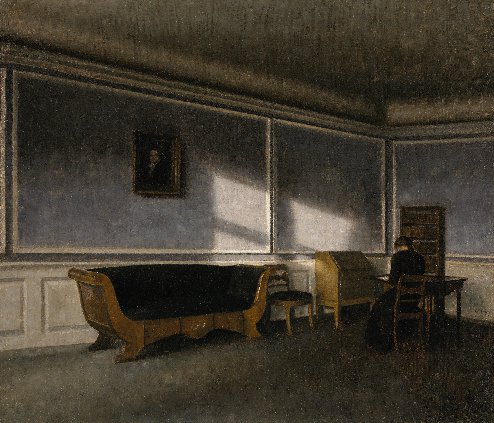
Sunshine in the Drawing Room by Vilhelm Hammershøi
These things do not eliminate suffering. They exist alongside it.
Perhaps that is enough.
Or perhaps “enough” was never the point.
The world remains capable of extraordinary cruelty. Human beings remain fragile creatures haunted by death and memory and longing.
But even amid suffering, life continues producing moments of unbearable beauty with almost reckless generosity.
One day consciousness reaches its final horizon. One day each of us disappears into that vast and unknowable dark from which no voice returns clearly. Yet before then there is still music. Still touch. Still sunlight through trees. Still the extraordinary fact that anything exists at all rather than nothing.
Perhaps the task is not to escape suffering entirely.
Perhaps the task is simply to remain awake within life long enough to witness both its terror and its beauty with equal honesty.
 The Monk by the Sea by Caspar David Friedrich
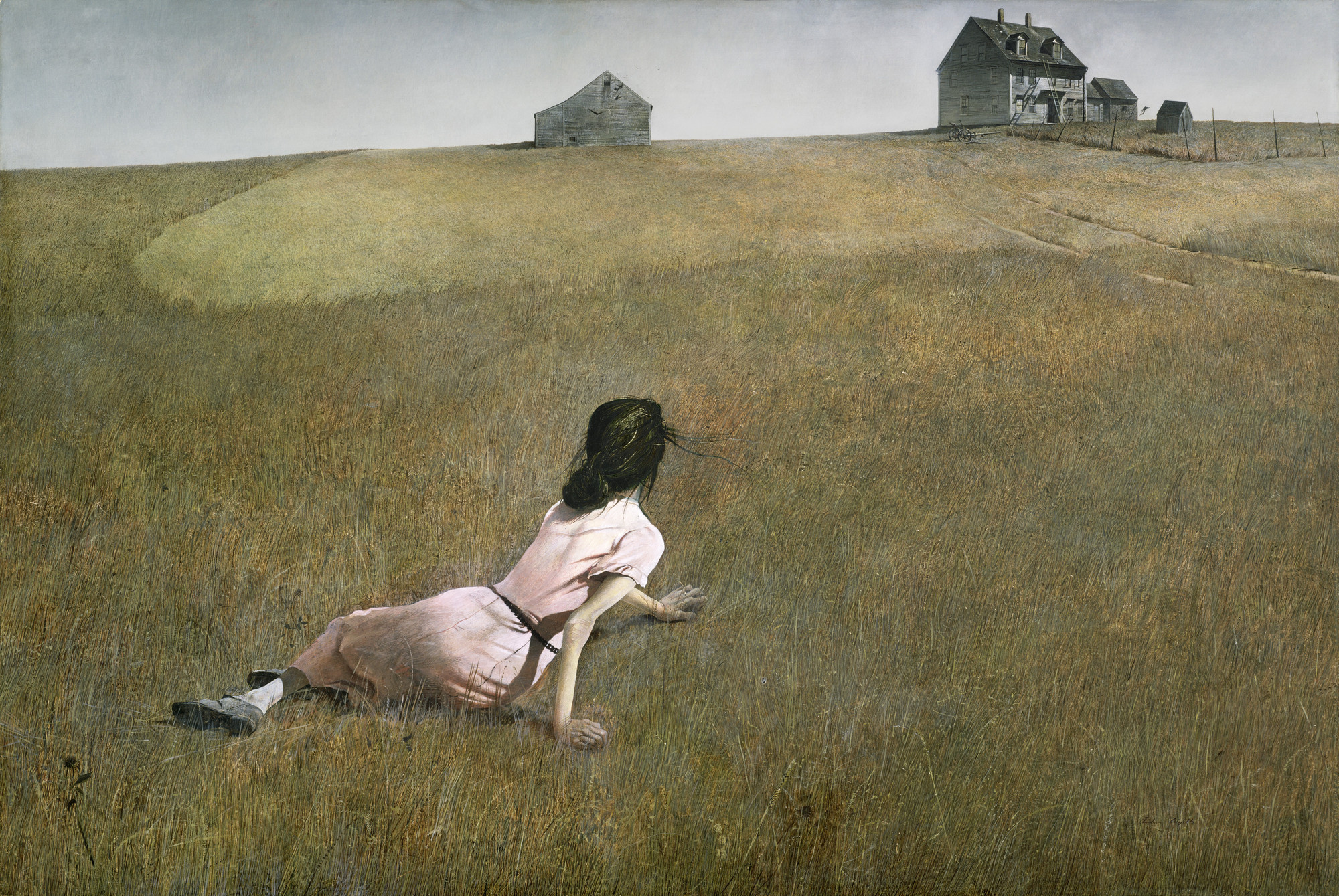 Christina's World by Andrew Wyeth